01
Frame the economics
Clarify incentives, behavior, constraints, trade-offs, and the economic mechanisms behind a research question.
ECONOMIC THINKING × DISCIPLINARY EXPERTISE
ERS–WVSU connects scholars across disciplines with economic reasoning, empirical research design, data analysis, and causal inference. Our seminars are designed to move promising work toward credible, policy-relevant evidence.

01 / THE VALUE WE ADD
Research in agriculture, education, health, science, business, and other fields often raises economic questions. ERS–WVSU offers a focused space to identify those questions and develop the empirical strategy needed to answer them.
Clarify incentives, behavior, constraints, trade-offs, and the economic mechanisms behind a research question.
Discuss data, econometric specifications, identification strategies, uncertainty, and causal interpretation.
Explore joint research designs, stronger papers, policy analysis, and interdisciplinary grant concepts.
Bring disciplinary expertise; explore what economics and credible empirical research can add.
Explore research partnerships02 / OUR COLLABORATION MODEL
Each collaboration begins with a real disciplinary question. We explore the economic and empirical angle, then agree on next steps and contributions.
A scientific problem, early result, or promising research idea.
Identify mechanisms, outcomes, incentives, and plausible hypotheses.
Discuss data, design, estimation, and credible interpretation.
Define scope, responsibilities, credit, and potential outputs.
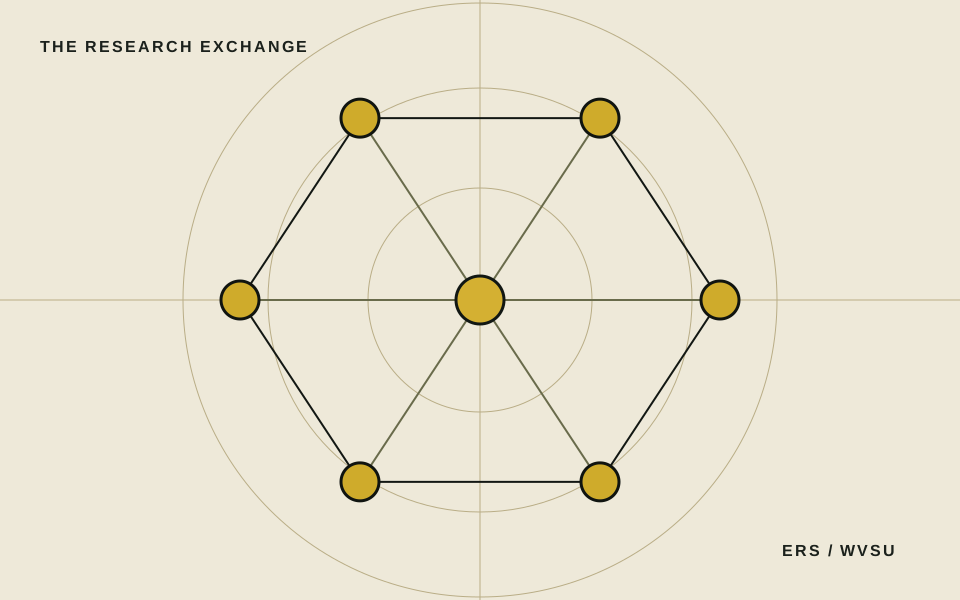
04 / ILLUSTRATIVE RESEARCH THEMES
These themes demonstrate the breadth of possible collaboration. They are not announcements of projects, grants, or institutional partnerships.
Economic choices, resource use, producer behavior, and agricultural markets.
Learning, skills, opportunity, and evidence on programs that affect outcomes.
Costs, access, incentives, and the distribution of benefits and risks.
Innovation, adoption, productivity, entrepreneurship, and labor markets.
Economic trade-offs, natural resources, shocks, and Appalachian communities.
Policy evaluation, institutional incentives, implementation, and welfare.
Representative areas of interest only. Detailed proposals and unannounced research remain with their respective teams.
05 / A PRECISE INTERDISCIPLINARY MISSION
ERS–WVSU welcomes research from any discipline when economic reasoning, quantitative analysis, or causal inference can meaningfully strengthen the work. The goal is substantive collaboration—not a general-purpose lecture series.
Our selection principles06 / START A RESEARCH CONVERSATION
Bring an early idea, a working study, or an unresolved empirical challenge. You do not need a finished economics component: discovering it together may be the first contribution.